
Foreword:
- I would like to extend my sincere thanks to J. Aaron Farr for his precise and prompt responses when I contacted him on LinkedIn. Without his insights, this article—which I have long been preparing—would never have been so inspired.
- Retail Mage was the subject of an in-depth analysis for my classes at ICAN Paris. The course materials remain exclusive to the school’s students. However, a few avenues explored during the course are revisited in this article.
Holodeck
There are some pop culture references I feel obligated to explain to my younger students. The “Holodeck” is one of them. For my generation, or rather the generation slightly older than mine, the Holodeck is an image that constantly comes up in discussions about Generative AI and storytelling—especially when commenting on “world models,” those AI pipelines capable of rendering infinitely explorable worlds, at least on paper.
Proof of this can be found in the heated discussions between John Radoff and Emmanuel de Maistre, which give a pretty clear idea of what GenAI maximalists expect from such technology for the future of video games.
In Star Trek, the Holodeck is a simulation, a virtual reality machine so powerful that the show’s heroes would swear it was the real world. So much so that the heroes venturing into it find many uses for it: combat training, emotional learning programs, or exploring a bygone era as a substitute for time travel…

The term has crossed over into Western pop culture to describe an infinite virtual world so refined that it could easily be mistaken for the real one. And as I write these lines, I feel it’s important to recall and explain this reference, so that older and younger generations alike—both of whom are building infinitely complex worlds using GenAI—can understand each other.
The second concept is more widely shared, but I’ll bring it up anyway. It’s the central figure of the tabletop role-playing Game Master. Yes, that kind of role-playing game, the one played around a table, the one cherished like the One Ring by an international guild of hardcore—even purist—aficionados. Personally, I don’t play TTRPGs because they make me uncomfortable. But I know the discipline well, notably thanks to Julien Pirou’s work on Nolife and his book, which I highly recommend (all in french, sorry…).
The last frontier is a warehouse
First and foremost, there is humor in the game we are looking at today. And that might not be as trivial as it seems. Truth be told, it’s essential. We will inevitably come back to this.
This game is called Retail Mage, released in november 2024. Developed and published by Jam & Tea Studios, the studio was founded in 2023 by industry veterans (ex-Riot Games, Blizzard, Wizards of the Coast). The key founders are J Aaron Farr (CTO), T Carl Kwoh (CEO), and M Yichao (CCO). Driven by the challenge of shipping an entirely new game in just 5 months, the team set out with a single idea in mind: Generative AI can change gameplay itself, not just production pipelines.
This game is now a reality, available on Steam for around 5 bucks. And throughout this article, I hope to make it clear to anyone willing to listen that it is an incredible stroke of luck that Retail Mage is available and playable exactly as intended—at least at the time of writing.
More Work?
The concept itself is pretty straightforward. You play as an intern at a knick-knack warehouse, a sort of bazaar where you can buy just about anything and everything—the kind of store you only find in commercial zones on the outskirts of mid-sized towns, where the dregs of Chinese cargo ships are dumped.
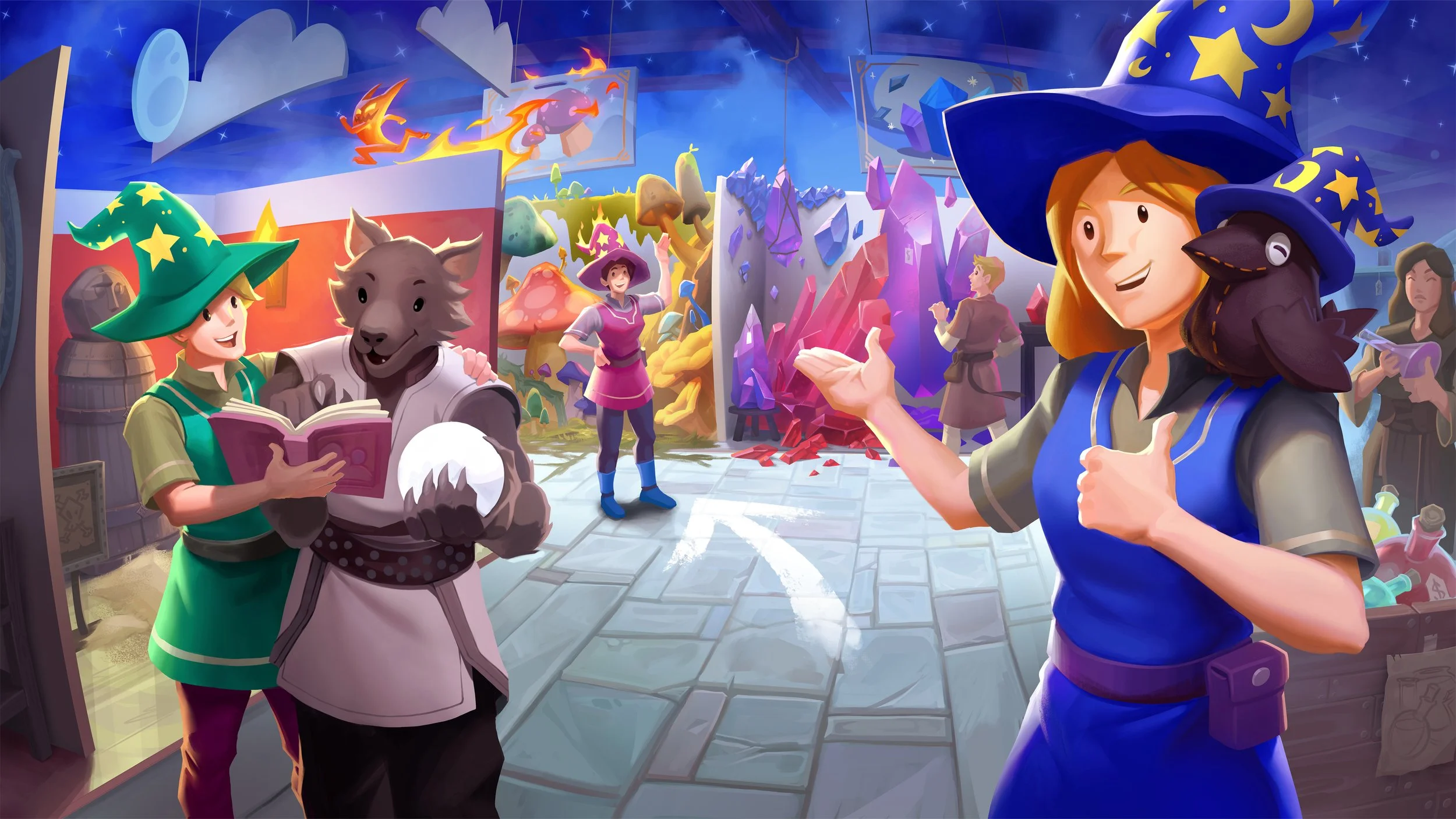
Except here, everything in the store is magical. To grasp the tone, picture a parodic world akin to Harry Potter shopping in Diagon Alley, though the overall vibe is closer to a Discworld forced into a shotgun wedding with Clerks.
The goal of the game? Close as many customer requests as possible in 30 minutes and get the highest ratings from them, using a familiar 0 to 5-star system. It’s up to you, young employee, to approach customers, get them to confess their wildest dreams, jot them down on your list, and fulfill them ASAP. The catch is that customer requests are entirely wonderful and fantastic—not to say downright whimsical.
Magic and Humor: The Ultimate Insurance Policy.
I intentionally circle back to the concept of humor, as mentioned earlier, to point out just how perfectly it blends with the game’s decidedly magical tone. And, at least in my opinion, this is no coincidence. Because, as we’ll see in detail, this clever combination skillfully—and not without a bit of narrative trickery—excuses the inherent quirks of the technology being used here.
They had to rely on the kind of insurance that only self-awareness can provide, so the gameplay resulting from the game’s highly unusual setup could convince players to go exactly where they need to go. Which is to say, quite far outside their usual gaming habits, where deterministic systems have reigned supreme since… forever.
The magical tone ultimately justifies these numerous moments of weirdness and unresolved loose ends. Moments of vague floating, which are fortunately offered with the full awareness of its creators, who assure us that this is less of an awkward compromise with imprecise technology and more of a clear, controlled intention.
In short, it’s like when kids play an abstract make-believe game, declaring one of those patented playground rules: “let’s pretend we’re in a magical world,” so they don’t have to bother with overly coercive logic.
At Your Service
Let’s focus on the actual gameplay now.
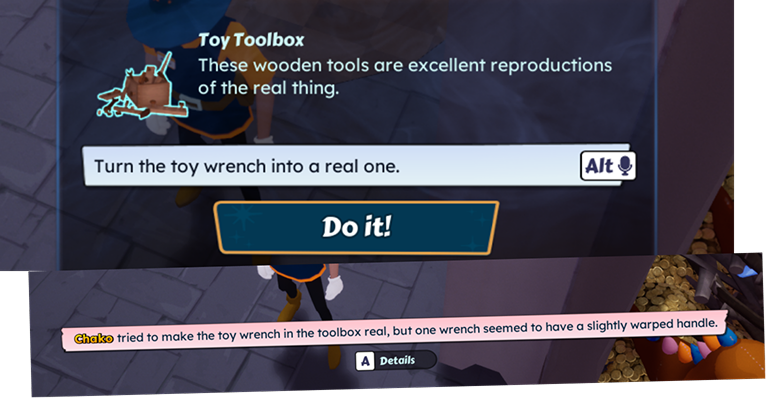
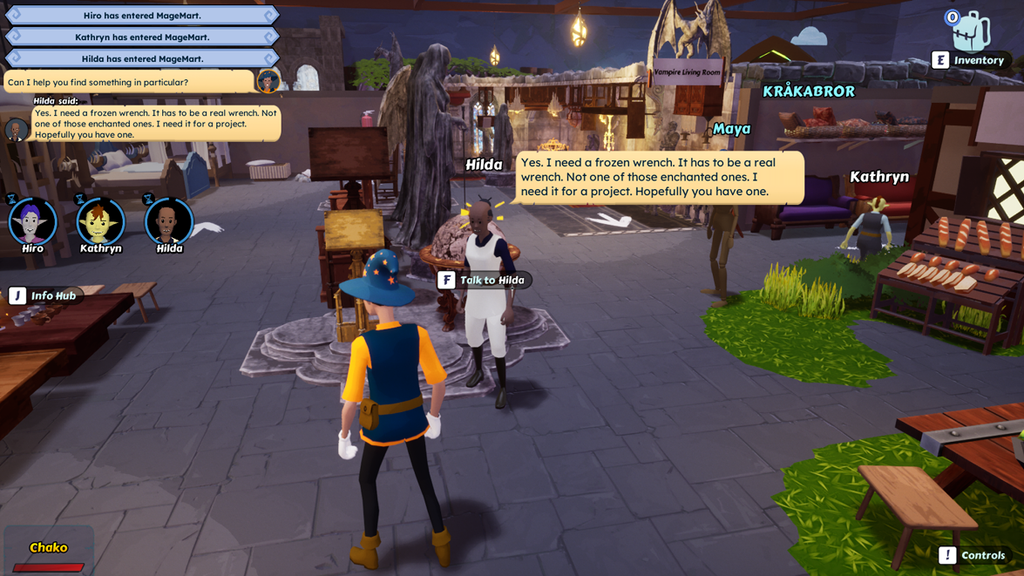
My first customer asks for an ice wrench. Alright. I wander through the store aisles and do find a wrench, but it’s a toy. I decide to take a two-step approach. A first magic trick to turn it into an adult’s wrench, and a second magic trick to make it a tool made of ice. Except… the system tells me no, right at the first trick. Impossible to turn this toy into a real tool. I fail, scraping by with only two out of five stars.
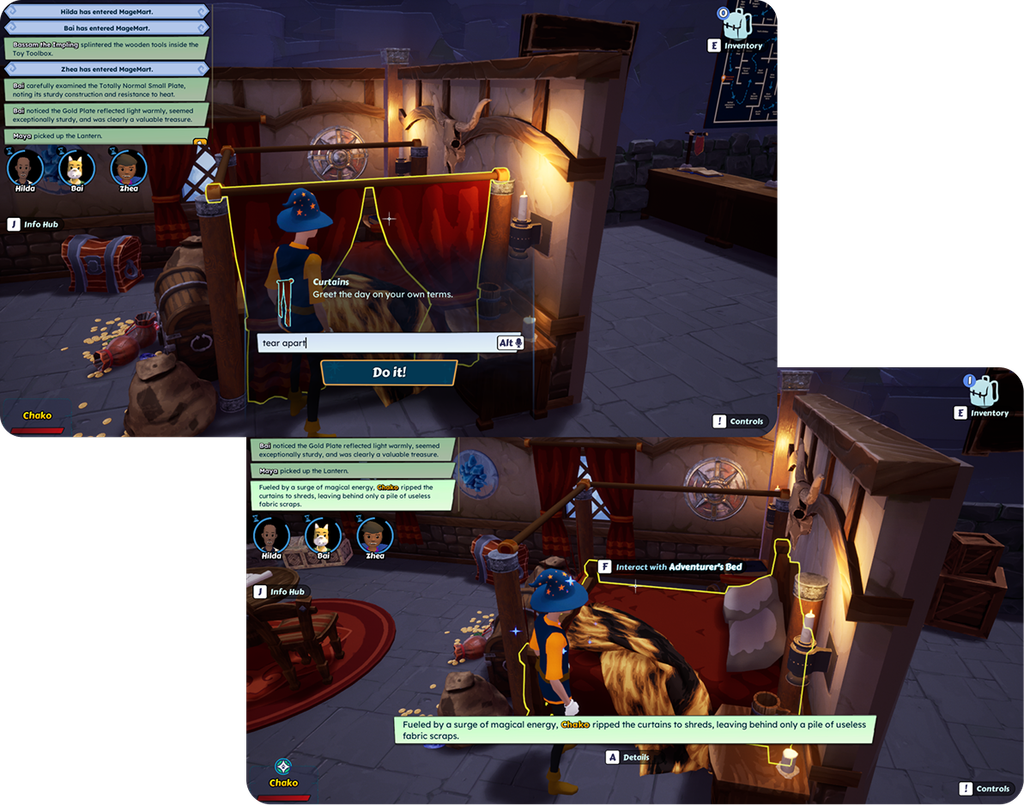
Before diving into a new request, I wander the aisles and realize I can interact not only with NPCs but also with the environment. And I can do it through text. I find a canopy bed, and with a simple text input—”tear down the curtains”—the system interprets my request, asks me to confirm via three clickable reformulations, and the result… the curtain is physically torn down. Come to think of it, isn’t this simple action, this simple result, more impressive than being able to talk to NPCs using natural language? We’ll come back to this.
My second quest leads me to another customer who asks for “a magic recipe book.” I grab an old grimoire, and with a little magic trick, it transforms into a magic recipe book. The thrilled customer gives me 5 stars. This time, I did much better.
Finally, a third, more spectacular request involves crafting, according to the customer: “a plushie made of other plushies, kinda like a chimera.” Luckily, I spot a small donkey plushie on a table, and further down, a plushie of Krakâbror, the store mascot. My magic trick works, delivering this highly rewarding system message: “Chako’s (my gamer tag) alchemical knowledge and a touch of magic allowed him to seamlessly stitch together the Donkey Plushie and the Krakâbror Plushie, creating a surprisingly light and impressive Chimera Plushie, leaving him feeling a surge of accomplishment.” Things are looking up.
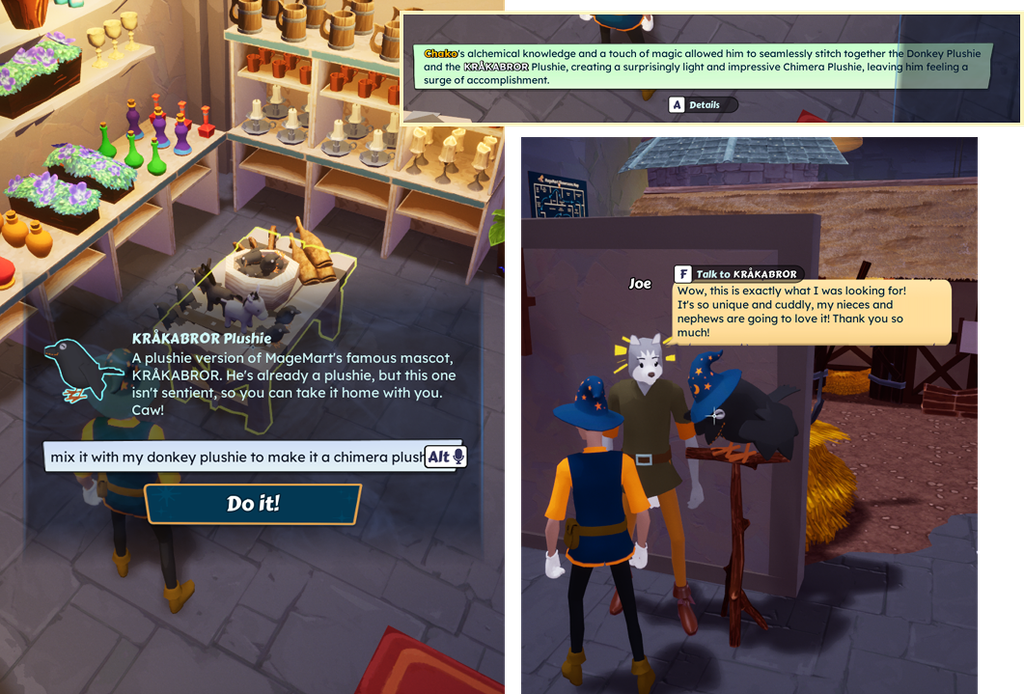
These are the three quests I managed to complete in my first play session, which resulted in a rather unglamorous overall rating…
Judgment as Friction
What I fundamentally take away from this experience, looking back on it a few weeks later, is that almost all the game’s tension lay in that exact moment you submit the magic trick to the system, never entirely sure if it’s going to work. This moment of critical friction, where thousands of parameters pass through a statistical funnel that must ultimately deliver a simple yes or no, clearly constitutes the dramatic beat of the game—the one you want to repeat over and over again.
Thinking about this, I can’t help but recall the American reality TV show Pawn Stars, which follows a family running a pawn shop dealing in (more or less) precious items. What keeps viewers loyal to this show is precisely the same adrenaline rush found in Retail Mage. Namely, those sequences where the camera gets dangerously close to the shop owner, and you try to guess from his mysterious gaze whether or not he’s going to accept the customer’s final, I-swear-this-is-it offer to buy back a pure ivory chess set for $10,000.
In Retail Mage, this is also the moment we come looking for. That moment right before the “deal” is resolved, resulting in either relief or disappointment. Everything else is just pageantry surrounding that specific instant.
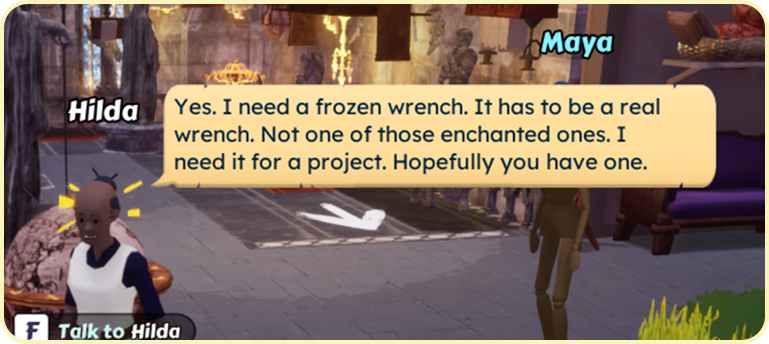
On the other hand, as the examples mentioned above attest, this moment isn’t always perfect, or even always enjoyable. The fuzzy logic, deliberately intended and embraced by the game’s developers, sometimes disappointed me with a lack of consistency and a rather messy judgment on what I submitted to the system. For instance, why couldn’t I turn the toy wrench into a real tool when I successfully changed an old grimoire into a recipe book? To answer this question, we have to look under the hood a little bit.
Abracadabra: The Magic is in the Tech.
Let’s take a closer look at what makes the system validate a magic trick or not.
Rules and Rulings
There are two main elements at play here.
The first is simply the rules of the game, strictly speaking. The model responds to clear rules. It knows what to do when asked to perform a magic trick. It’s not going to respond by offering a poem, for example. It is aware that it’s in a game built on specific rules, and it follows them. So far, pretty simple.
The second element lies in how the model—which governs the game’s entire logic—has been fine-tuned. To achieve this, the developers trained their model by feeding it a multitude of micro-questions, almost as if installing conventions rather than strict rules.
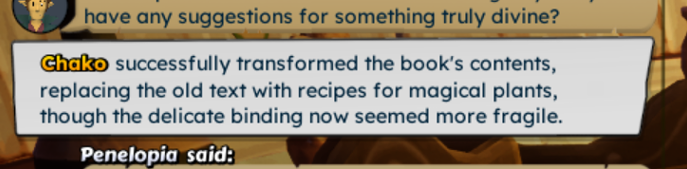
It is through this practice-by-example that this exchange was prepared and forged, reminiscent of an interaction between a tabletop role-player and their Game Master. Except in the case of Retail Mage, this game master exercising authority over the overarching narrative is decentralized across the NPCs and the context layer in which they evolve.
In doing so, the developers always try to ensure that the narrative continuity works in the player’s favor, and is always backed by logic—even if that logic is meant to be blurry (hence the term fuzzy logic)—so that the underlying model can stretch its elasticity within the web of conventions.
Openweight and Inference
Ah, inference. How many times have I heard this word used to sound the alarm? If you listen to many people, inference—this computational “digestion” of an input sent to an LLM, paired with its output—is an astronomical cost that, if triggered by millions of players at once, could bankrupt studios! Nothing less. Let’s gloss over the fact that, clearly, too many people are anxious about the prospect of having too many players.
Jokes aside, it’s still a serious topic because Retail Mage, unlike a game like Portopia which computes everything locally, does rely on cloud-based LLMs.
Simply put, it’s as if the game integrated your everyday AI chatbot into its UI. The game sends server requests, where complex computations take place, before you receive an answer. It’s this operation that costs money, especially if you use so-called “closed” or “proprietary” models (the ones you use daily via chatbots like ChatGPT, Gemini, Grok, Claude…).
That’s why Jam & Tea opted for what are known as “openweight” models. Unlike closed proprietary models, openweight models allow the studio to fine-tune them specifically. This trains the AI to provide answers that are more consistent with the tone and personality of each character in the game.
Using these models, combined with direct management of their own cloud GPUs (AWS)—notably leveraging sglang technology—was the key factor in slashing inference costs.
In this regard, the studio boasts having successfully divided its inference expenses by 1,000, dropping the cost of a play session from hundreds of dollars to just a few cents.
As a result, Jam & Tea achieves the feat of bringing to market a title where the narrative and even some gameplay are driven by generative artificial intelligence, all while solving the existential problem—in their own words—of inference cost.
At the Speed of the Visible World
Let’s go back to our torn curtain after I simply requested it.
It is not easy to be highly impressed by this simple action and its visual nature, but… As a reminder, I just interacted with a canopy bed curtain and typed with my little fingers on my keyboard: “tear down the curtain“. And the game executed it, producing a visible result. Nothing groundbreaking at first glance, except that once again, much like the narrative exercises we just discussed, the elements composing this simple action weren’t necessarily linked by a deterministic common denominator.
A simple concatenation of separate elements then aggregated together by logic driven by a standard LLM? Yes, but we tend to forget one thing: the execution speed of an LLM is absolutely not the same as that of a video game physics engine. In one, the idea marinates, steeps, and takes shape in gestation. In the other, it’s a signal traveling as fast as the electricity powering your lightbulb when you flip the switch.
And Jam & Tea had to find a practical way, not exactly to marry, but to try and co-house these two paradigms so that the illusion—the curtain tearing because I willed it so—worked properly.
To resolve the conflict between the blazing speed of traditional physics engines and the latency of LLM inference, the studio entirely disabled Unreal Engine’s standard physics. The engine’s physics simply ran too fast, creating “race conditions” where objects reacted before the AI had time to send its signals or judgments.
Instead, they implemented a simplified physics model designed specifically to sync up with the AI’s decision-making rhythm. Concurrently, to minimize LLM latency, they ditched simple external API calls in favor of directly managing their own GPUs on AWS via sglang, utilizing structured generation.
Allons-y to the Holodeck
For a Narrative Designer, or anyone who has dedicated their time to making a person interact with a machine for fictional purposes, there is, in my view, no frontier further away than the Holodeck.

Any endeavor dedicated to building emergent, organic, and autonomous worlds governed by guidelines that respect its author’s vision will always be the kind of endeavor that drives me, just as it has driven my work over these past few years.
The Legacy of Retail Mage
Right now, or at least at the time of writing, Jam & Tea Studios is using the game as a tech showcase to prove that generative AI can radically transform gameplay by enabling “improvised play” where the system interprets the player’s free-form intent in real time.
Armed with the lessons learned from this project, the studio is developing INFUSE, a high-level framework designed to simplify the deep integration of AI into traditional game systems (quests, economy, items) to create worlds as reactive as a Holodeck.
Simultaneously, Jam & Tea is launching Earl Grey, a “compiled reasoning” platform born from their own production infrastructure, which optimizes AI agent workloads by delivering higher accuracy, 8.5 times faster speeds, and a massive reduction in costs compared to today’s state-of-the-art models.
I hope to revisit this new adventure soon, because reading their manifesto, I was personally moved by how accurately they identified the problems of why—oh why—the video game industry still doesn’t have GenAI in its tech stack, at least for narrative purposes. Their approach feels like the right one, especially since their solution is both ready and battle-tested with Retail Mage.
And on a philosophical level, I can only support this journey, which helps craft the new experiences of tomorrow, rather than just replicating existing experiences faster and cheaper—which is sadly how AI exploration in video games is often perceived.
Still and Always a Matter of Design
Retail Mage is, to my mind, one of those great leaps forward in the direction that drives me—which we will continue to call, for the sake of this article, the Holodeck. Just like Portopia before it, it is one of those quiet adventures that serve as building blocks toward this ultimate goal of constructing emergent and intelligent worlds.
The game surprised me, even contradicting my own convictions, whereas I’ve been swearing since I began my narrative work with GenAI that you have to tame the beast, dumb it down with a litany of strict rules, and constrain it like water flowing through tightly brazed copper pipes, all in the hopes of finally making it spit fire.
In stark contrast to this vision, Jam & Tea implemented and embraced this “fuzzy logic” for Retail Mage, where conventions matter more than rules, and where a certain flexibility is allowed—encouraged, even.
This goes against my intuition when I conceptualized Aarda, because the challenge there was quite the opposite: the worldbuilding had to establish rules so precise, and loaded with so much authority, that it would be impossible for an LLM to escape them. ([
However, I have to ask: could this diffuse logic have worked dramatically if the game in question wasn’t so loaded with humor and even somewhat self-deprecation? Would we have tolerated such approximations if the world of Retail Mage had been a Fantasy universe in the purest tradition of the genre? Only time will tell, and I bet Jam & Tea’s work, present or future, will eventually answer that question.
Retail Mage on Steam: https://store.steampowered.com/app/3224380/Retail_Mage/
Retail Mage Homepage: https://www.jamandtea.studio/retail-mage
Jam & Tea Studio: https://www.jamandtea.studio/
